
State-of-the-art
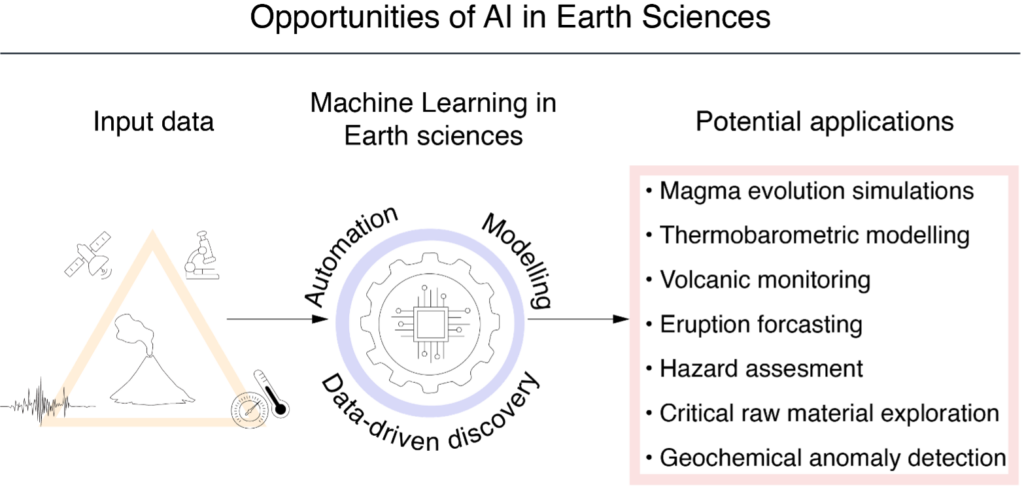
Volcanic eruptions represent the most extreme outcome of magma’s lifecycle . While they pose significant hazards to societies and economies, magmas also act as the primary engines for the concentration of mineral deposits , , hosting critical raw materials (e.g., lithium, platinum group elements, rare earths, and copper) that are indispensable for modern society in general and the energy transition in particular. However, understanding magmatic systems remains one of the greatest challenges in Earth sciences . Their dynamics are highly non-linear, span spatial and temporal scales from nanometres to kilometres and from seconds to millennia, and cannot be observed directly. Researchers must rely on indirect monitoring techniques (seismicity, gas emissions, deformation), laboratory experiments, numerical models, and analyses of volcanic and plutonic products. Addressing these complex challenges requires a paradigm shift in how we integrate diverse data sources and interpret complex processes. Machine learning (ML) has driven significant advances across multiple sectors, including medicine, mobility, the Internet of Things, and precision agriculture . Also, ML algorithms have successfully contributed to advancing our knowledge in Earth Sciences , including petrology and volcanology . In igneous petrology and volcanology, Machine learning offers clear benefits, notably in automating routine tasks, strengthening modelling workflows, and accelerating knowledge discovery.
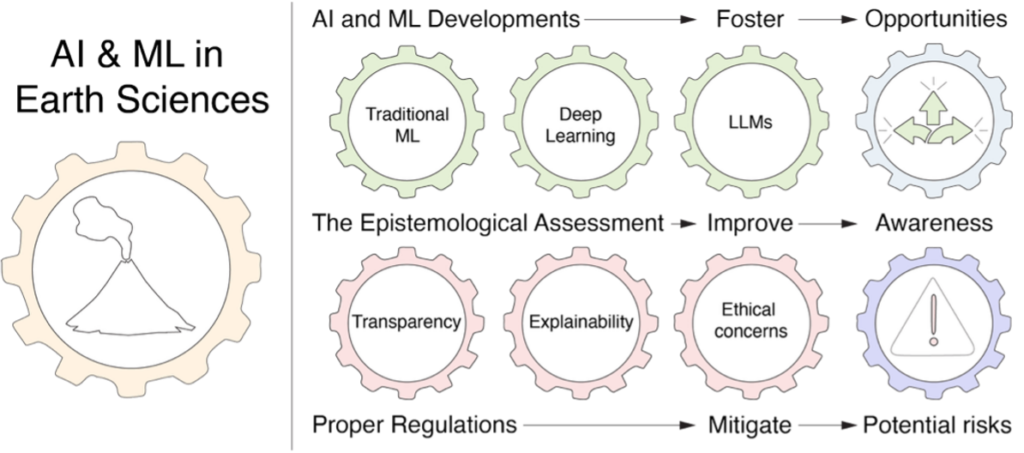
Fundamental topics include the genesis of magmas, the origHowever, the integration of ML/AI into scientific research raises critical challenges (Figure 2): these include clarifying what ML models actually learn, ensuring transparency, reproducibility, and improving explainability. These requirements are especially acute in high-risk settings, such as volcanic hazard assessment, risk mitigation, and crisis management, where decisions informed by ML can raise ethical concerns, with direct consequences for public safety. These issues align with broader debates on responsible AI use, highlighted for instance by the EU AI Act , which emphasizes transparency and oversight for high-risk applications.
Beyond the state of the art
REALI3SE combines advanced petrological and geochemical approaches with rapidly evolving AI paradigms. It will advance the geochemical, petrological, and volcanological community on three fronts, expected to shift current practice: (1) REALI3SE will significantly improve multimodal data acquisition, fusion, and modelling in igneous petrology. (2) REALI3SE will substantially enhance current computational fluid dynamics (CFD) and thermodynamic modelling by complementing them with state-of-the-art machine learning (ML) methods. REALI3SE will deploy generative AI, ML-based hypothesis formulation, and symbolic regression to propose and test physically plausible relations and hypotheses that support new discoveries and the development of new knowledge in geochemistry, ore geology, and volcanology.
Progress will be evidenced by the development of new multimodal data acquisition, fusion, and modelling methods, AI tools based on visual programming, and the development of interdisciplinary and intersectoral case studies worldwide.